
.jpg)
Conjuntos and totems
Totems
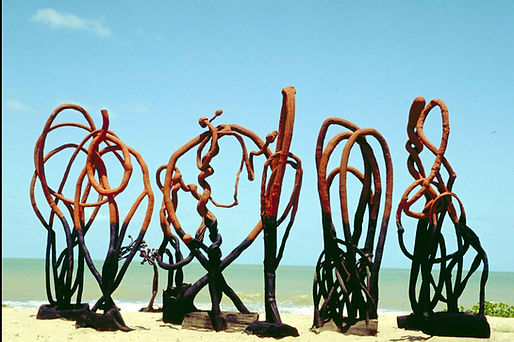
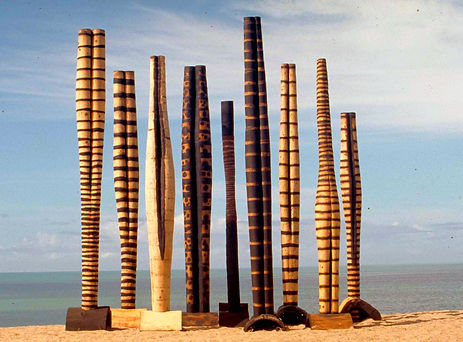
Frans Krajcberg does not copy nature but seeks, through creation, to enter into a relationship with it. Some sculptures are large and heavy, giving the impression that they want to remain rooted in the ground. Their closed forms, even when they contain internal voids, give them undeniable power. Others seem to strive to break free from the earth, with upward twists pushing them skyward. Finally, some perform both movements simultaneously: reaching both upward and downward.
Palmeiras
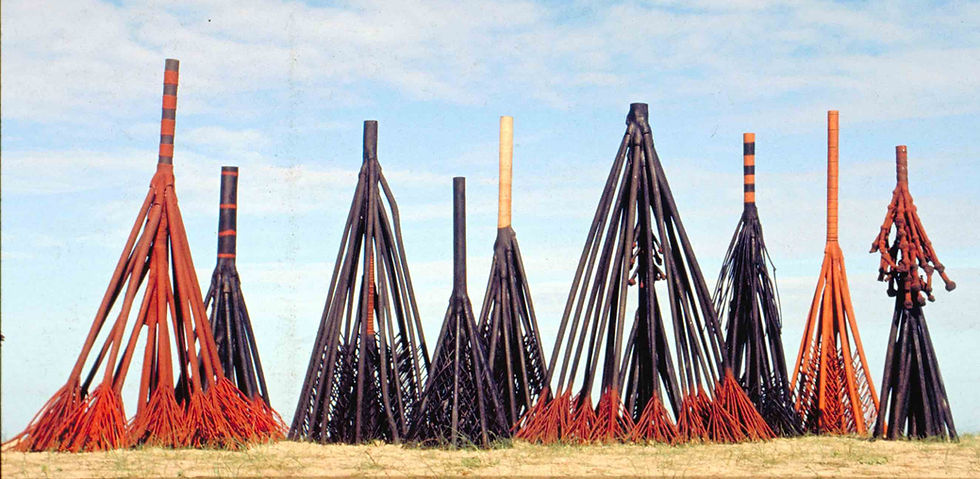
The artist brings back from his travels in the Amazon, to places struck by fires, dried palm trunks, which he uses to compose sculptural ensembles called “conjuntos.” Like rain sticks or totems, they denounce deforestation, just as his photographs do. The Indian inspiration runs through these vertical trunks, marked by wide scars, which he likes to gather “in the forest,” on the beach, and photograph in full light. Once again, this is a way to restore strength and life to destroyed elements.
For works made from this type of material, the creative process begins by removing the damp, soft mass remaining inside the trunks, leaving only the shell. The piece is then trimmed with a few cuts along the stem. The cracked parts are mostly covered with black or red pigments. New burns are made with a blowtorch to harden the wood.
Africanas
According to Federico Morais, Frans Krajcberg’s decision to settle in the state of Bahia — a place many consider a piece of the African continent within Brazil — and his exposure to Candomblé inspired him to create the Africana series in the late 1980s. With this series, he went even further in his approach by incorporating other materials such as lianas, sticks, and stems from various trees, most often charred, into the palm trunks. Although not explicitly religious, these sculptures carry a shamanic aspect and bear a clear connection to the garments used in many African rituals.
.jpg)
_edited.jpg)