

His story
© Veja Dedoc, 1996
Youth in Poland
Frans Krajcberg was born on April 12, 1921, into a Jewish family in Poland, in Kozienice, a small town located about 210 kilometers south of Warsaw. His family was modest and large—five children in total.
For young Frans, the forest became a sanctuary: a place to hide from the bullying he endured at school, where his classmates harassed him simply for being Jewish. “In the forest (near my village), I found the only place where I could reflect and ask questions. I suffered deeply as a child from the cruel racism bred by religion—fanatics who tolerated nothing beyond their narrow beliefs. I kept wondering: Why was I born there? Why not in a country where I might be less hated?”

Frans Krajcberg in 1945
His father was a shoe merchant; his mother, Bina, was a well-known communist activist within the Polish party. In the 1930s, the Communist Party and so-called subversive literature were banned in Poland—something that only strengthened Bina’s resolve. For her, “education was the path to the emancipation of the people.”
Frequently imprisoned, Bina Krajcberg fought an unwavering battle. She was hanged by the Nazis in 1939, on the very day war was declared. Frans Krajcberg, then 18 years old, was summoned to identify her body at the prison in Ramdam, near Warsaw. He had just enough time to retrieve his mother’s necklace—a pendant that would become his lifelong talisman. Undoubtedly, Bina’s character and convictions shaped her son: escape the intolerable, fight to survive.
After his mother’s death in 1939, near Warsaw, Frans returned to his hometown of Kozienice—only to find no trace of his family. Imprisoned in a church where the Nazis had rounded up the village’s Jews, he managed to escape, fleeing into the forest. Dodging bullets, he crossed the river and made his way to freedom.
Russia, the War and the Camps
Alongside other Polish resistance fighters and survivors, Frans Krajcberg joined the Polish Red Army in the Soviet Union. In Vilnius, he met Mordechai Anielewicz, who would later lead the Warsaw Ghetto Uprising. Stricken with illness, Krajcberg was hospitalized in Minsk, where he began to paint during his convalescence. Later, in Leningrad, he enrolled at the Academy of Fine Arts while simultaneously studying hydraulic engineering. It was during this time that he also learned Russian.
In Leningrad, Frans Krajcberg met Natacha, his first great love. In 1941, when the Reich launched its attack on the USSR and laid siege to Leningrad, Krajcberg fled the encircled city. For weeks, he ran between falling bombs, caught in the deadly no-man’s-land between the German and Soviet fronts. Natacha died before his eyes on the road to Minsk, as they took refuge in the forest to escape the bombardments.
He was later drafted into the First Polish Army and sent to Tashkent, in Central Asia, where he worked as a technical inspector on Uzbekistan’s dam systems. To conceal his Jewish identity, he assumed a false name. In 1943, he joined the Second Polish Army as an officer assigned to bridge construction. He became the personal pontoon engineer to Marshal Zhukov.
It was Krajcberg who built the bridge that would allow the liberation of Poland. He was the first soldier to enter liberated Warsaw—walking alone, far ahead of the advancing armored columns.
With the Red Army, Krajcberg came face to face with the existence of concentration camps—the unspeakable horror that would scar him for life. In July 1944, he entered the Majdanek camp near the Russo-Polish border. He had been told that his parents might be among the prisoners. What he saw there etched itself into his very being: the scale of human madness made flesh. The image of “those mountains of bodies, heaped together in chaos,” where his parents may have been, haunted him for the rest of his life.

Frans Krajcberg in the uniform of the Polish army.
When he returned home, the family apartment was occupied. A woman slammed the door in his face, calling him a “dirty Jew.” It was then that he resolved never to set foot in Poland again. He threw the two medals awarded to him by Stalin over the Czechoslovak border and made his way to Stuttgart, where he made one final, fruitless attempt to find survivors from his family. All had perished in the Holocaust. “I left the concentration camp in a state of indescribable shock, silenced by horror (…). Every time I see the piles of Amazonian trees burned by men, I cannot help but think of the ashes from the crematory ovens: the ashes of life, the ashes from the fire of men gone mad.”


Chronicles of Nazism, 1945, metal engraving, 12 x 16 cm, Stuttgart
Bauhaus School
In Stuttgart, Frans Krajcberg learned German and studied at the Academy of Fine Arts under Willy Baumeister (1889–1955), a Bauhaus professor who had chosen to remain in Germany and resist the regime. It was there that Krajcberg discovered the world of avant-garde art—vilified by Hitler but alive with radical creativity.
“Baumeister’s teaching was open-minded, stimulating, and generous. He carried forward the spirit of the Bauhaus and trained us in every technique. To support his students, he had created a prize—funded from his own pocket. I won it twice. He invited me to his home and advised me to go to Paris. He even wrote me a letter of recommendation for Fernand Léger.”
Within just a few months, Krajcberg had developed a solid understanding of Modern Art and its major movements. “That’s where I learned everything about the Bauhaus, about the great movements in Modern Art—we discussed Cubism, Cézanne... After everything I had lived through, I felt much closer to Expressionism than to Concrete Art.” He became convinced that he had to follow this path. Art, for him, began to act as a form of redemption.

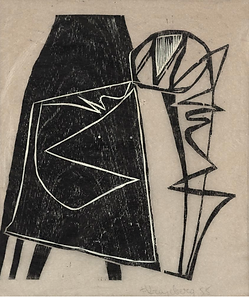
© Juan Esteves for the Frente Galery
Post-War Montparnasse
In Paris, Fernand Léger hosted him for three months. Yet, Krajcberg soon realized that Europe would not help him to truly live again. He needed a radical change of life. Marc Chagall, whose family he had known in Vitebsk, helped him take this new step. A friend of Chagall’s who worked in immigration suggested he move to Brazil. Brazilian law at the time allowed the immigration of foreign women who were married or about to be married.
This friend knew a young Hungarian woman from a wealthy family willing to pay for Krajcberg’s passage in exchange for a “white engagement” — a marriage in name only. Krajcberg agreed, without even knowing where Brazil was. They traveled separately, he in third class, she in first. Krajcberg never saw his “fiancée” again. He arrived in Rio de Janeiro in 1947, beginning a new life on unfamiliar soil. At 26, Frans Krajcberg had everything to reinvent.
The Discovery of Brazil
Upon his arrival in Rio, penniless, Frans Krajcberg slept on the beach at Botafogo. In 1948, he moved to São Paulo, where Francisco Matarazzo had just opened the Museum of Modern Art. Matarazzo hired Krajcberg as a warehouse worker. Very quickly, Krajcberg integrated into the city’s artistic circles. He mingled with the “self-taught painters” of the Família Artística Paulista: Volpi, Cordeiro, Mario Zanini—who introduced him to the Osir Arte studio, where Krajcberg executed azulejos commissioned from Portinari for major Modernist architectural projects.
In 1951, Krajcberg directed the installation of the First São Paulo Biennial, where Max Bill won the Grand Prize. The following year, Bill would become the leader and one of the founders, alongside Cordeiro, of Brazilian Concretism. That same year, Frans Krajcberg retreated to paint in Itanhaém, a coastal village, in Mario Zanini’s house, which Zanini often visited with Alfredo Volpi. This landscape-inspired period was exhibited at the Museum of Modern Art, yet Krajcberg sold nothing. The aftershocks of war and material hardship made life in São Paulo harsh. He felt he had “lost all moral identity.”
In 1952, Lasar Segall reached out to Frans Krajcberg. He bought one of his drawings and sent it to the paper mill managed by the Klabin family in Monte Alegre, Paraná, south of São Paulo. This was the artist’s first encounter with Brazilian nature—a true revelation. Frans Krajcberg was dazzled by the wild, lush forest! He left the paper mill and retreated into the forest to paint. Gradually, in close contact with nature, he was reborn.
“Since leaving Stuttgart, I had been a lost man (…) I hated people. I avoided them (…) But isolated as I was, why live? Nature gave me strength, rekindled my joy in feeling, thinking, working—to survive. I walked through the forest and discovered an unknown world. I discovered life. Pure life: to be, to change, to continue, to receive light, warmth, moisture. True life: when I am in nature, I think truthfully, I speak truthfully, I ask myself true questions. When I look at it, I feel how it moves: birth, death, the continuation of life. I built my house in the forest. A wild cat adopted me. I collected orchids. I probably had the largest collection of orchids in Brazil.”

Alfredo Volpi, Mario Zanini, Bruno Giorgi, unknown and Frans Krajcberg in São Paulo in 1950
For two years, Frans Krajcberg lived off his ceramic creations—pottery, azulejos, statuettes. He painted self-portraits, still lifes, and botanical subjects.
Krajcberg lived in an ecologically managed forest, but he could not bear to see the Paraná’s nature slowly destroyed by fire and human exploitation. In 1955, his own house in the forest was destroyed in an arson fire. His drawings, paintings, ceramic works, and rare orchid collection all went up in flames. Once again, Frans Krajcberg lost everything.
He returned to Rio, sharing a studio with Franz Weissmann. He exhibited jointly with Milton Dacosta and Maria Leontina at the Petite Galerie in Rio, and held a solo show at the Paraná Public Library. He began painting a series of abstract landscapes, the “Samanbaias” (ferns), reminiscent of Paraná. His work explored linear networks of plant density on blue-toned backgrounds, which he began to enrich with earth pigments while preserving openings of light.
In 1957, Frans Krajcberg won the prize for Best Brazilian Painter at the São Paulo Biennial, where Franz Weissmann was named Best Sculptor and Jackson Pollock received the Grand Prize. The following year, Krajcberg acquired Brazilian nationality. Suddenly famous, he sold his paintings and returned to Paris.

Samambaia, oil on canvas, 1955, 71 x 59 cm

Frans Krajcberg and Samambaias, 1952-54

Samambaia, oil on canvas, 1955, 60 x 49 cm
In France, Frans Krajcberg found himself immersed in the intellectual and artistic debates of the late 1950s: the Algerian War, the crisis of the École de Paris, and the controversies surrounding Abstraction. Poisoned by turpentine, he stopped painting and began shifting his focus toward a more immediate engagement with materiality. He created collages and woodcuts on Japanese paper, producing his first “direct wood prints” using the molded paper technique.
“I was very fortunate upon arriving in Paris, as I managed to survive. I had a few collectors (…) I sold all the gouaches I made in my hotel room to Rosa Fried for her gallery in New York. Mostly, I bartered my paintings for meals at restaurants—the Coupole and, across the street, the Hungarian-run Patrick. At the Coupole, I met Sartre and Giacometti, whom I admired greatly. I still do. He was the last artist to do something significant with the human figure: he condensed its entire expression into those small heads. In Paris, the talk was mostly about Tachisme: Soulages, Hartung, the gesture. I witnessed the death of Tachisme. Paris is stimulating, but I felt lost there. I had stopped painting. Even back in Rio, turpentine was poisoning me. I fled to work.”

After a year, Frans Krajcberg increasingly felt the need to work with natural materials, as close as possible to the beauty of the elements surrounding him. In 1958, he moved to Ibiza, where he returned regularly until 1964. Living on almost nothing in a cave near the sea, he began photographing nature, honing his eye and sharpening his sensitivity day by day. He created his first “rock and earth prints” and paintings incorporating natural elements.
He met the critic Pierre Restany, who wrote, “Nature is his studio… It is both his subject and his medium.” Whether through direct imprints, assemblages, or scenographic treatments, Krajcberg was a marginal pioneer of Arte Povera.
In 1955, Frans Krajcberg was awarded the Best Painter Prize at the São Paulo Biennial by President Juscelino Kubitschek.
“I fled to work. I went to Ibiza. For the first time, I felt the need to experience the material itself—not paint. I made imprints of earth and stones. Then I took the earth directly, adhering it onto surfaces. It might resemble a kind of Tachisme, but it isn’t. It’s not thrown paint. There’s no painterly gesture. These are imprints, recordings—fragments of nature. After that, I could no longer work in Paris. Where would I find my earth?”
He then traveled to the Amazon for the first time.

1960, Frans Krajcberg in Ibiza, rock impression in progress
In 1960, Frans Krajcberg was made an honorary citizen of Rio de Janeiro, receiving the keys to the city. The following year, he participated in the exhibition Reliefs in Paris, organized by San Lazzaro, who directed the Galerie and the Revue du XXème siècle. Jean Dubuffet, whom he admired, appreciated his use of materials. Georges Braque befriended him and became his mentor. They collaborated on two lithographs, one of which Braque incorporated into his final “papier-collé” painting.
“I admired the audacity of the New Realists and their freedom. They sought to break away from the formal machinery of Abstraction without reverting to figuration. They wanted to move beyond the gestures of painting. And they dared to make a gesture of showing. Showing what? The nature of cities. (…) The artist must not only engage with nature but also participate in their era (…) Today, the human figure serves advertising and electronic imagery (…) Their ‘second nature’ of the cities is not mine. That’s why I never sought to join the New Realists, whom I knew well. I belong to the minority who understand the importance of nature in humanity’s future, and my work expresses that.”
That same year, Krajcberg met Michèle, a French woman with whom he lived for four years. He also befriended the photojournalist Roger Pic, who lived on Allée du Montparnasse.
He undertook a second journey to the Amazon.
In 1964, Frans Krajcberg’s imprints and paintings made with earth and stones earned him a prize at the Venice Biennale, where the Grand Prize that year was awarded to the American artist Robert Rauschenberg.
Invited to Minas Gerais, he returned to Brazil and established his studio at the foot of Itabirito Peak, amidst iron ore fields whose soils are pure pigments. It was a dazzling display of colors. Krajcberg began creating his first macrophotographs and used natural pigments to enhance his works made from collected dead wood. He worked his paintings by applying a mixture of earth and glue onto paper dried in the sun, then redrawing the surfaces.
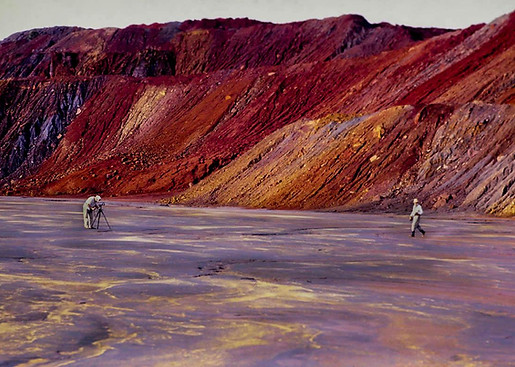
© Vilma Slomp, Frans Krajcberg in Minas Gerais
“The mountains were so beautiful that I began to dance. They shift from black to white through every color. The convulsive waves of vegetation growing among the rocks filled me with wonder. I was overwhelmed by beauty and wondered how to create art that was equally beautiful. One feels impoverished before such richness. It anguished me, I was afraid of it. My work is a long, passionate struggle with nature. I could show a fragment of that beauty. I did. But I cannot repeat this gesture endlessly. How can I make this piece of wood my own? How can I express the awareness I have of it? Where is my participation in this life that includes and surpasses me? Until now, I have not dominated nature. I have learned to work with it. (...) I discovered color, the pure pigment earths — colors that are substances. There are hundreds: ochres, grays, browns, greens, an immense range of reds. Since ’64, all my colors come from Minas. (...) I gathered dead wood from the ore fields and made my first sculptures by coloring them with earth pigments. I wanted to give them a new life. That was my naïve and romantic period.”

© Frans Krajcberg, Minas Gerais
In the early 1960s, Frans Krajcberg established his Parisian studio on Chemin du Montparnasse—the very alley where the Espace Frans Krajcberg now stands. There, he developed his techniques in woodcut printmaking and direct wood engraving, alongside a series of assemblage paintings created from sculpted flowers coated with natural red pigments.
In 1965, over coffee at Les Deux Magots, his friend José Zanine Caldas told him about a small village called Nova Viçosa, in the state of Bahia. Caldas was launching a multidisciplinary project there, bringing together artists and intellectuals such as architect Oscar Niemeyer and singer Chico Buarque de Hollanda.
They aimed to create an artistic movement in response to the technocratic uniformity of the International Style, drawing directly from the richness of local materials. In Brazil, naturally, wood took center stage!
This deep connection to material and memory aligns with the “Tropicalismo” movement then sweeping the arts. Enchanted, Frans Krajcberg set out for Nova Viçosa, its forest, and its seashore. There, he constructed his first atelier based on Zanine’s designs and made it his dwelling. He lived there alone. The group’s grand utopian dream could not withstand the isolation of the place.
To learn more about his atelier perched high in a tree, click here.

© Tim Carrol

Frans Krajcberg began working in Paris on his “cut shadows.” The idea was to capture the play of light on natural elements whose shapes fascinated him. The shadow is first drawn, then cut out of a wooden support. In the earliest pieces, the sharp, geometric cuts—“constructive” or “concretist” in style—contrasted with the fluid natural lines of the forms they outlined. Over the years, the cuts grew closer to the shapes, like the refined effect of lateral lighting.
“I first got the idea in Minas, but it was in Paris that I made my first cast shadows. I wanted to break out of the square, to go beyond the frame. I had more than one reason for that. Nature ignores the square; movement is circular. (…) Life is not square and doesn’t have fixed forms. (…) The abstraction of the square accompanied the revolutions of the early 20th century, just as Expressionism accompanied their misery. I have always had an Expressionist sensitivity and never identified with Concretism. I didn’t want art for art’s sake. I wanted to find new forms. Nature offered me thousands.”
“I owe more to Arp’s cut woods than to Matisse’s cut papers. (…) My search consisted in trying different lightings to choose a shadow. There are infinitely many. No two people make the same shadow, and a single person’s shadow always moves. I wanted to unify the object with its shadow.”
I was seeking to find the object within its shadow. I looked to nature for a way to be reborn into the life of art by uniting with forms different yet drawn from it. The cast shadow added a new shape to it. That was my participation.
In 1967, Frans Krajcberg married Alba, a young Brazilian from Bahia, daughter of wealthy doctors from Salvador. She was an art history student writing her thesis on Vassily Kandinsky. The couple separated three years later.
In 1969, Frans Krajcberg was invited to the exhibition Art et Matière in Montreal.
Between 1972 and 1974, Krajcberg settled in Nova Viçosa. There, he created his first “polished woods,” assemblages of dead wood from which he revealed architectural lines: hollow trees or mangroves, bathed in light. “When I saw the mangroves, I was struck. I come from Tachisme, from Parisian Abstraction. How to capture the life of these forms, their changes and vibrations? Soto succeeded with his ‘Penetrable’ at the MAM in Paris. In this white vibration, I found the Amazon forest.”
Krajcberg also made his first “sand prints,” cast directly on the beach at low tide. Facing the sea, he spent hours watching the waves ebb and flow and the alternating strength of the winds. As the water receded, it inscribed on the sand an unlimited repertoire of grooves and ripples. On Japanese paper, without glue, he captured nature’s imprints directly into plaster before printing them on the paper’s reverse side. These revealed the texture of the earth—the “skin of the world”—in minute detail. From this living nature—sand and later vegetation—remained a matrix inscription that faithfully records, grain by grain, the original material and scene, forever memorialized. The imprint was then mounted on canvas or wood.
The absence of frame or margin heightened the originality of a “raw” work, far from traditional easel painting. Removed from its horizontal origin to be exhibited vertically, the natural object became an artistic artefact that immortalized a life doomed to disappear. For Frans Krajcberg, this was a way to mourn it openly before the world. In this approach, he was the first to use the interpenetration of painting and sculpture so fully. His artistic intervention allowed them to come together closely in a mutual exaltation that Paul Klee called “the soul of creation”!
In 1975, Frans Krajcberg was invited to Paris to exhibit his works at the Centre National d’Art Moderne, the future Georges Pompidou Center, which was still under construction. This was the first exhibition organized under its label. There, he met Claude Mollard, then Secretary General of the Centre Pompidou. Pierre Restany wrote the exhibition catalogue, and the show was widely praised by critics. It sparked passionate debates with the public, which reinforced Krajcberg’s determination not only to show the forgotten nature but to denounce nature threatened by the global expansion of the third technological revolution.
“There was something stirring inside me. A commitment was growing. The debates at CNAC clarified it. They took place twice a week, after the screening of my slides. I became aware that Art for Art’s Sake was over, and I want my sculptures to bear witness to this disaster.
My sculpture has become engaged. It is my revolt that I want to express. There is only one choice for the modern artist. Either their art participates in our third industrial revolution — the electronic revolution — and thus supports progress, or it fights against its consequences, against this pollution as dreadful as atomic bombs.
We must choose. And I have chosen to fight, to express myself not only with the beauty of nature’s forms but with this nature that we are killing. Today, my sculptures stand as a memorial to the disaster I see and live amidst.”

Frans Krajcberg became increasingly sensitive to the destruction of the Amazon rainforest by man-made fires. His work grew arduous, and his suffering lay just beneath the surface. The wounds left open by the loss of his family during the war deepened as he witnessed hectares of forest disappearing before his eyes.
In front of his own home, he installed a massive sculpture eleven meters tall, titled Memory of Destruction.
Stripped of their substance, two dead, dried, and burned tree trunks are embedded one into the other and raised toward the sky. Their dramatic silhouette speaks of mourning for the vegetal world, but also the human body — a remembrance and refusal to forget the past. Like African ancestors buried at the heart of homes to protect the living tribe, this sculpture serves as a spiritual guardian of the artist’s private space.
In a harmonious coexistence with the forest, Frans Krajcberg inhabited his land like an indigenous village. He created there. Facing the sea, he "exhibited" his sculptures for photographing them against the ocean, like in a natural museum.
In 1976, he embarked for Mato Grosso in the Amazon with Sepp Baendereck, whom he had met the previous year. Sharing a passion for defending nature, they remained united in this cause until Baendereck’s death in 1989. Together, they undertook three Amazon expeditions (1976, 1977, 1978) and three journeys to Mato Grosso (1985, 1986, 1987).
With Pierre Restany, Krajcberg traveled through Minas Gerais and Piauí.

© Tim Carrol

Photo of Amazonas, Brazil. All rights reserved
Pierre Restany and Frans Krajcberg
"Original nature must be exalted as a hygiene of perception and a mental oxygen: an integral naturalism, a gigantic catalyst and accelerator of our faculties to feel, think, and act."
"The notion of naturalism is the expression of planetary consciousness (...) The naturalist option, opposed to the realist option, is the fruit of a choice that engages the totality of individual consciousness. This option is not limited to expressing man's fear of the danger posed to nature by excessive industrial civilization."
"Integral naturalism is an answer. And precisely by its virtue of integrism — that is, the planetary expansion of consciousness — it today presents itself as an open option, a guiding thread amid the chaos of contemporary art."
— Pierre Restany, Manifesto of the Rio Negro, 1978 (excerpts).

"Amazonian nature challenges my sensitivity as a modern man. It also calls into question the scale of aesthetic values traditionally recognized. The current artistic chaos is the conclusion of urban evolution. Here, we face a world of forms and vibrations, the mystery of continuous change. We must learn to make use of it. Integral nature can give a new meaning to the individual values of sensitivity and creativity."
Pierre Restany, Minas Gerais, 1976
“The Rio Negro Manifesto was launched the very day Brazil was opening up to democracy: the military had just granted amnesty to political opponents. It was the first debate after the dictatorship, and the destruction of the forests had never been discussed before. The attacks were fierce. Some couldn’t accept that three ‘gringos’ were speaking about Brazil. The manifesto was presented in Curitiba, New York, Paris, Rome, and Milan.”
— FRANS KRAJCBERG
To read the full Manifesto by Pierre Restany, click here.
In 1980, Frans Krajcberg began creating his polychrome plant prints in Nova Viçosa. Between 1982 and 1983, after a trip to the Belém region, he crafted monumental “woven basketry” pieces inspired by local crafts that naturally let light pass through.
But a decisive shock came in 1985, during his first journey to Mato Grosso, a wild and lush region in central Brazil. He witnessed helplessly the intentional fires set by large landowners to clear land for extensive cattle ranching. Outraged, he produced a lengthy photographic report on the burning forests, titled “Queimadas”, which clearly exposed the role of humans in this massive destruction.

© Sepp Baendereck, Frans Krajcberg in Mato Grosso, 1984
Frans Krajcberg is, and will remain, an active activist who relentlessly shows and denounces. From this trip, the artist brings back dried palm trunks, from which he creates several groups of sculptures called “conjuntos.” Like rain sticks or totems, they denounce deforestation, just as his photographs have done. The indigenous inspiration runs through these vertical trunks, streaked with light and shadow, which he gathers in the forest.
“I always wonder why, just as I wondered as a child. Why does man destroy natural wealth when he knows the planet is being exhausted and that without it, his own life will be impossible? Why is Brazil becoming desertified when it is one of the richest countries on the planet? For immediate gains of land, forests are destroyed, destroying the future, alongside utter poverty. Society is a commercial machine, and the thought of art has sunk within it. Where is the artist in these issues?”
The following year, he published his book of photographs Natura and returned to Mato Grosso to continue his fight.
I search for forms to embody my cry
In 1987, Frans Krajcberg traveled for the third time to the state of Mato Grosso. The filmmaker Walter Salles joined him there to shoot a film about his life: Krajcberg, Poet of the Remains (45 minutes, awarded Best Documentary at the Festival dei Popoli in Florence). “Krajcberg was the greatest influence of my life,” the director declared upon the artist’s passing.
Krajcberg’s entire body of work is now fully committed to the environmental struggle. To express his revolt, he seeks inspiration in the shapes offered by the mistreated nature around him. He wants to alert, denounce, and shout to the face of the world the harm caused by destruction by giving new life to natural elements.
“I show the violence against life that goes against nature. I express a revolted planetary consciousness. Destruction has shapes, even though it speaks of the non-existent. I do not seek to make sculpture. I seek forms for my cry. This burnt bark, that is me. I feel myself in the wood and stones. Animist? Yes. Visionary? No, I am a participant in this moment. My sole thought is to express everything I feel. It is an enormous struggle.”
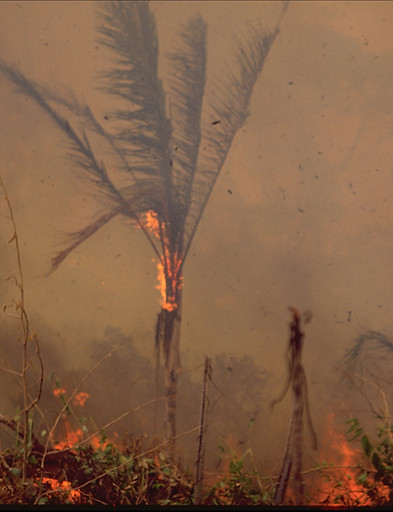
© Frans Krajcberg, Mato Grosso, 1980

“Painting pure music is no easy task. How can a sculpture cry out like a voice? Surely, my work carries cultural echoes, remnants of the war buried deep in the unconscious. With all the racism, all the antisemitism, I could not create any other kind of art. But above all, I express what I saw yesterday in Mato Grosso, in the Amazon, or in the state of Bahia.”
© Frans Krajcberg, Mato Grosso, 1980
I am a man marked by fire
"I am a man marked by fire. Fire is death, the abyss. Fire has been with me always. My message is tragic. I show the crime. I gather the evidence, I add to it—I want to give my revolt the most dramatic and violent face. I want my works to be a reflex of burns."
From the late 1980s onwards, after his trips to Mato Grosso and the Amazon, Frans Krajcberg began working with "burned wood," collected from sites of deforestation. His "Revolts" are assemblages made from burnt natural elements—trunks, vines, roots… gathered in forests devastated by fire, then transformed with a blowtorch. The fire hardens the wood, giving it a certain strength. The works are then enhanced with black or red, colors derived from vegetal charcoal, stones, or natural pigments, which protect, heal, and camouflage like war paint.

Set on natural bases and pierced by light, his "burned woods," steles or totems, resonate like tragic alarm sirens. With them, Frans Krajcberg asserts that death is not an end. He defies it through his sculptures. The elements, purified, transformed, and magnified, are reborn. His "burned barks" echo his "burned woods." Between painting and epidermal fragments, their tragic economy contrasts with the theatricality of the "conjuntos."
The Witness
Frans Krajcberg is outraged by the criminal destruction of the Amazon rainforest, which burns day and night, filling the horizon with black smoke. "The massacre I witnessed in the Amazon forest, I have never seen anywhere else, not even during the war." He was the first renowned artist to actively use his photographs and sculptures to denounce the fires. He also stands up for the people of the Amazon, with whom he feels a close bond through their traditions, way of life, and art.
On December 22, 1988, Chico Mendes, the first to defend ecological awareness both in Brazil and beyond its borders, was assassinated. His efforts had helped save nearly 1,200,000 hectares of forest. Frans Krajcberg paid tribute to him by sculpting a wounded rubber tree, incised with deep red lines evoking blood. A commemorative plaque in pyrographed wood bears the name of the martyred activist.
In Rio Branco, in the state of Acre, Frans Krajcberg tirelessly photographed the devastated forest and gathered scattered elements for his sculptures. He tried to convince farmers to give up cutting down trees, which earned him several death threats in return. He met the indigenous spiritual leader, the “Cacique” Raoni, and committed himself alongside him to defend the cause of the Amazonian indigenous peoples, with whom he maintained close and militant friendships until his death.

_edited.jpg)
My art is a manifesto
From the 1980s onward, Frans Krajcberg’s growing renown allowed him to act on the international stage and assert himself as an artist-activist. He was invited to exhibit his work across the globe. His series “Révoltes” was shown in Cuba, New York, and Stockholm. In 1988, he took part in the Environmental Symposium in Seoul and, alongside artists, joined the movement “Doctors Without Borders” in Romania.
The 1990s brought the full recognition of his “ecological” art. In 1990, he was invited to Moscow for the International Congress of Ecology — his first return to Russia since his studies at the Leningrad Fine Arts Academy. In 1992, the Modern Art Museums of Salvador and Rio honored him. At Rio, his exhibition “Imagens do Fogo,” held during the United Nations World Conference on Environment, drew over 300,000 visitors. In Paris, the “Latin Americas” exhibition at the Centre Georges Pompidou showcased several of his works.
In 1996, he was central to the exhibition “Villette-Amazone” at the Grande Halle de la Villette. Curated by Jacques Leenhardt and Bettina Laville, this exhibition stood as a manifesto that placed the environment as a defining issue of the 21st century. In 1998, he exhibited at the Fondation Cartier in the show “Être Nature.”
Far ahead in raising awareness of planetary issues, Frans Krajcberg’s role in the 1980s and 1990s positions him today as one of the founding figures of the Anthropocene movement, which recognizes humanity’s decisive role in the planet’s balance. For the artist himself, he is “at the heart of every project of civilization, fully and radically.” Art, for him, is a force to transform society. Throughout his life, Frans Krajcberg dreamed of radical artistic gestures: “The absolute gesture would be to unload, as they are, a truckload of charred wood collected from the field, straight into an exhibition. My work is a manifesto. I do not write—I am not a politician. I must find the image. If I could scatter ashes everywhere, I would be as close as possible to what I feel.”
_edited.jpg)
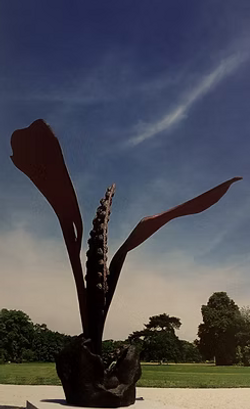
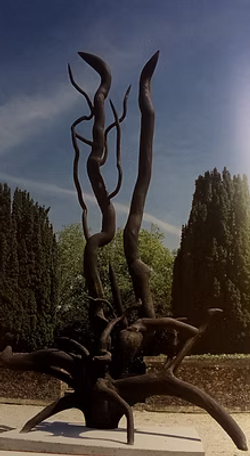
Photos de l’exposition « Dialogues avec la Nature », Bagatelle, 2005
The Cry for the Planet
In 2003, Frans Krajcberg was honored in the exhibition "Art and Revolt" organized at the new Musée du Montparnasse, located on the alley where his studio stands. Thérèse Vian Mantovani was the curator of the exhibition. He donated a collection of emblematic works to the City of Paris, to be displayed at the Espace Frans Krajcberg at 21 avenue du Maine, inaugurated by the Mayor of Paris, Bertrand Delanoë, in December.
In Curitiba, Paraná, a museum bearing his name was opened in the botanical garden. In Nova Viçosa, he built a small museum near his home. He released the second edition of his book Nature et Révolte.
In 2005, it was Brazil Year in France. The City of Paris organized a large retrospective exhibition in the Parc de Bagatelle. Titled Dialogues with Nature, it paid tribute to and gave voice to both the artist and the activist. Frans Krajcberg worked closely with Sylvie Depondt, General Curator, Brazilian producers, and the Parks and Gardens teams. Nearly one hundred works were shipped by cargo from Nova Viçosa. The "burnt woods" were exhibited outdoors for the first time. The large totems stood out on the lawns and faced the trees of the Bois de Boulogne. Franco-Brazilian debates on the role of urban and peri-urban forests were organized, with active participation from Paris, Rio, and São Paulo. Gilberto Gil, then Minister of Culture of Brazil, invited on this occasion, encouraged “each of us to reconsider Nature through Art.” The exhibition and debates were a great success: 450,000 visitors attended. For Frans Krajcberg, it was the opportunity to launch his Cry for the Planet: a militant and artistic call to awaken sleeping consciences.
For more information on the Bagatelle exhibition, click here.
At the same time, the documentary film Portrait of a Revolt, directed by Maurice Dubroca and produced by Eric Darmon (Mémoire Magnétique productions, 2004, 52 min), FIPATEL 2004, UNESCO Documentary Prize 2004, was broadcast on France 5.
To watch the documentary, click here.
That same year, a bronze sculpture was installed on Place de la Vache Noire, in Arcueil, and a work was installed at the Embassy of Brazil as part of the exhibition Between Two Lights.
The Recognition
In 2008, Frans Krajcberg was awarded the title of "Citizen of Bahia" by the State of Bahia. His photo book Queimadas, clearly denouncing the harmful effects of deforestation, was published with the support of the government.
He participated in the exhibition O Grito – Ano Mundial da Árvore (The Cry – World Year of the Tree) at the Palacete Das Artes Rodin in Bahia. In São Paulo, he exhibited at Ibirapuera Park and at the OCA for the 60th anniversary of the city’s Museum of Modern Art, and took part in every biennial. He received the Best Exhibition of the Year award from the Art Critics Association and was granted the title of "Citizen of São Paulo."
In 2011, he exhibited at the Museum of Contemporary Art in Niterói, in the suburbs of Rio.
.

In 2012, his work was showcased in João Pessoa, in Natureza Extrema, for the inauguration of the Estação Cabo Branco Museum. He received the prestigious Enku Grand Prize in Gifu, Japan, and was awarded the Vermeil Medal from the City of Paris in recognition of his entire body of work.
In 2016, in São Paulo, he was the guest of honor and featured artist at the 32nd Biennial.
Between 2016 and 2017, in Paris, the Musée de l’Homme invited Frans Krajcberg as the “first whistleblower” in its newly renovated galleries. His works were displayed in the section titled Where Are We Going?, sparking reflection and debate. Events centered on his life and work were organized. The Frans Krajcberg Space hosted performances and the research activities of the Musée de l’Homme’s scholars.
The Manifesto of Integral Naturalism
The “Cry for the Planet,” launched from Bagatelle in 2005, continues to bring together activists and figures from the world of Art and Culture around Frans Krajcberg’s fight for environmental protection. Yet the fate of the Amazon remains at the core of his concerns. In 2011, he launched a “Cry of Hope for the Amazon” and co-signed an open letter to the UN advocating for the creation of an International Year of the Amazon, alongside other prominent figures (Thiago de Mello, João Meirelles, André Trigueiro, Christiane Torloni, Vitor Fasano, Regina Jeha, and Mario Mantovani).
In 2013, 35 years after Pierre Restany’s “Rio Negro Manifesto,” Frans Krajcberg and Claude Mollard issued the “New Manifesto of Integral Naturalism.” The text reaffirms the artist’s fundamental role in defending Nature. In the face of threatening globalization, they radicalize the terms of the first Manifesto. They claim the right to diversity and the duty to respect the planet—integrally and radically! Artists are citizens of the world. As such, drawing inspiration directly from Nature, they must create a movement capable of raising public awareness.
For more information on the “New Manifesto of Integral Naturalism,” click here.
In 2015, for the occasion of COP 21, the artist launched a major movement in France and Brazil with the Akiri association to amplify his “Cry for the Planet.” France, Brazil, and Peru, together with representatives of Indigenous peoples and artists, united to demand that the protection of the Amazon rainforest—the guardian of the ecological, climatic, and cultural balance of our planet—be included in the climate negotiations held in Paris in December 2015.
Exhibitions, conferences, symposia, and screenings were organized to raise the voices of the peoples of the Amazon rainforest, in partnership notably with the Quai Branly Museum, the Yves Rocher Foundation, SNCF, Yann Toma, Anouk Garcia, Oskar Metsavaht, Vincent Carelli... The presence of Indigenous leaders and artists in Paris speaking out for the Amazon forest represented a unique opportunity to meet them and support their projects.

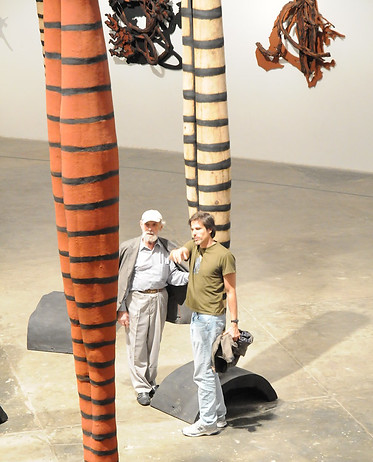
“To Convey and Carry Forward”
Frans Krajcberg passed away on November 15, 2017, in Rio. His ashes now rest in Nova Viçosa.
In 2019, the Frans Krajcberg Space, closed since his death, reopened with a renewed identity and strengthened mission: to continue Frans Krajcberg’s fight, to disseminate and promote his work, and to champion the awakening of consciousness and the (re)connection between humanity and Nature. From now on, its programming brings together all those who wish to commit themselves to the service of life, Art, and the planet around his message and his legacy.
Frans Krajcberg spent his life denouncing destruction. Yet, he always preserved his sense of wonder, with eyes and soul in constant alert. Every day, he honed his artist’s gaze and nourished his engaged vision by tirelessly photographing the details of the Nature that fascinated him and whose remarkable resilience he admired. With him, we seek to raise awareness, awaken consciences, and act to foster hope—two messages he entrusted to us and which we aim to carry forward here.
“The forest is pure life. Being, changing, continuing, receiving light, moisture, true life. When I look at nature, I feel how everything moves: is born, dies, the continuity of life... Nature challenges my sensitivity as an artist and a man.” — Frans Krajcberg.

© Vilma Slomp