Imprints
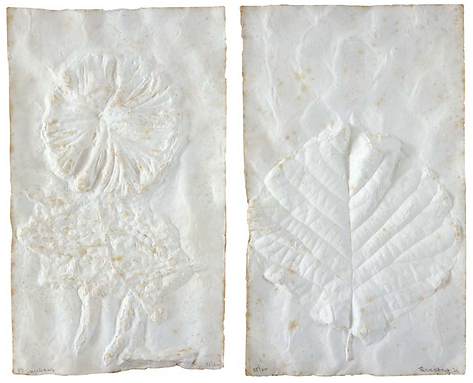
At the end of the 1950s and beginning of the 1960s, Frans Krajcberg moved away from painting. He sought new methods to engage with materials more directly. He created collages and woodcuts, and produced his first “direct wood prints.” Prints, engravings, assemblages, or scenographic treatments… his artistic intervention directly incorporates natural elements into the work, a mutual exaltation that Paul Klee called “the soul of creation”! The absence of frames and margins emphasizes the originality of a “raw” work, distancing itself from easel painting. In this approach, he was the first to use the interpenetration of painting and sculpture so fully realized.
With engraving, he was equally bold and pioneering. His experiments were recognized and unique. Frederico Morais, the great Brazilian art critic, preferred the term “anti-prints” to describe his imprints. Once again, rejecting the studio— which he called the “engraving kitchen”— Frans Krajcberg scorned the link between matrix and copy, drawing inspiration directly from rocks or mineral residues.
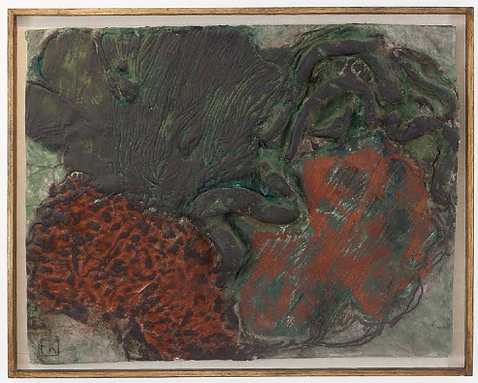
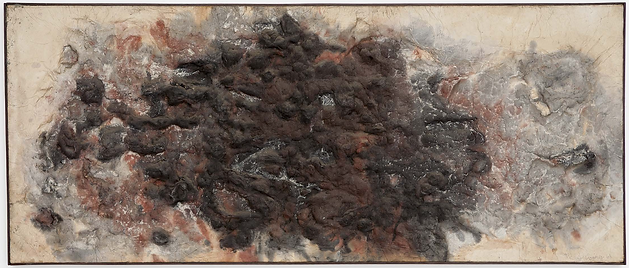
In 1958, he flew to Ibiza, where he returned regularly until 1965. On the island, he lived with almost nothing, alone in a cave near the sea, and began exploring photography. It allowed him to train his eye daily and sharpen his sensitivity. He made his first “rock and earth imprints” and paintings composed of natural fragments. “I fled to work. I left for Ibiza. And for the first time, I needed to feel the material, not the paint. I made imprints of earth and stones. Then I took the earth directly, sticking it on. It looks like a kind of Tachisme. But it isn’t. It’s not thrown paint. There’s no pictorial gesture. These are imprints, recordings. Pieces of nature. After that, I couldn’t work in Paris anymore. Where could I find my earth?” He also used direct stamping techniques on wet Japanese paper. The only intermediary between him and the rock, it allowed him to capture all the traces inscribed on the ground. Ground and paper are both matrix and receptacle, imprint and body. The earth swells and breathes; the veins of the rock prepare to receive color and leave marks on the pristine paper. The result is surprising, each piece unique, sometimes measuring up to two meters long.
From the 1970s onwards, settled in Nova Viçosa, Brazil, Frans Krajcberg created “sand imprints,” molded directly on the beach at low tide. Facing the sea, he observed for hours the ebb and flow of the waves and the alternating strength of the winds, while retreating water inscribed an unlimited repertoire of grooves and ripples in the sand, which he directly recorded onto Japanese paper—without glue—before molding them in plaster. Printed on the reverse side of the paper, they reveal the texture of the ground, “the skin of the world,” in its smallest details. The matrix inscription, reproduced grain by grain, could then be mounted onto canvas or wood.
%2C%201967%2C%20empreinte%20sur%20papier%20japonais%20num.jpg)
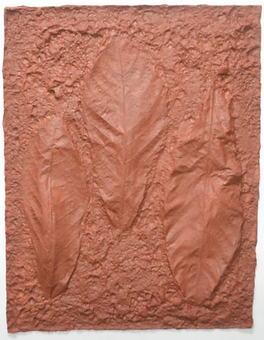
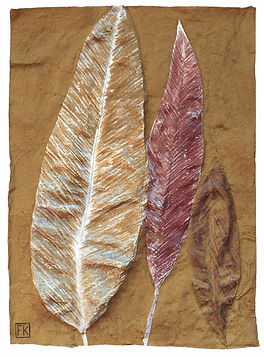
These appropriations of natural elements, beyond the artistic gesture that exalts their beauty, grant the chosen, reshaped objects the status of works of art. Through this, they immortalize a fragment of life destined, like humans, for disappearance. Frans Krajcberg finds in this a new way to mourn and confront the world.
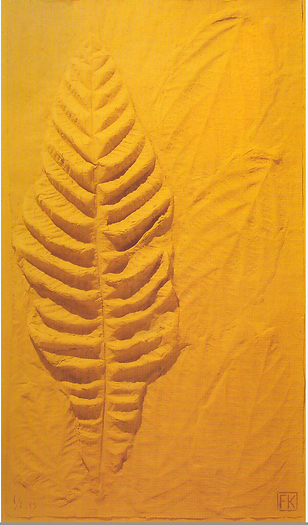
In the 1980s, Frans Krajcberg created his polychrome plant imprints. His intervention became more pronounced. To enhance the beauty of the natural elements he gathered, he chose the bright colors of natural pigments from the open-pit mines of Minas Gerais. He personally collected these pigments and applied them directly onto the chosen forms, not hesitating to outline them in black. This was a new way to reconnect them to Mother Earth, but also a very recognizable style that became his signature.