
The Revolt of Frans Krajcberg
In 1960, the establishment of the capital of the Brazilian state in Brasilia deeply unsettled Frans Krajcberg. The construction of the Brasilia-Belém highway opened an irreparable breach in the lush nature he loved so much… For him, it became urgent to act.
“My sculpture became engaged. It is my revolt that I want to express. There is only one solution for the modern artist. Either his art participates in our third industrial revolution, that of electronics, and thus commits to progress, or he fights against its consequences, against this pollution which is as dreadful as atomic bombs. One must choose, and I chose to fight, to express myself no longer with only the beauty of nature’s forms, but with this nature that is being killed. My sculptures today are like a memorial to this disaster that I see, in the midst of which I live.”
Far ahead in the awareness of environmental issues on a global scale, Frans Krajcberg definitively engaged in this struggle in the early 1970s, making him one of the founding figures of the Anthropocene movement, which assigns humanity a decisive role in planetary balance. Art, because it touches our deepest sensitivity, gives him the means to act on our society and places it “at the heart of any civilizational project, integrally and radically.”
Throughout his life, Frans Krajcberg dreamed of radical artistic gestures: “The absolute gesture would be to unload, as is, a truck of charred wood collected from the field into an exhibition. My work is a manifesto. I do not write: I am not a politician. I must find the image. If I could put ashes everywhere, I would be closest to what I feel.”
He comes into contact with the forest inhabitants, with whom he feels close due to their traditions, way of life, and art. His work is difficult, sometimes putting his life in danger, and reveals a pain that lies just beneath the surface. The wounds left open after the destruction of his family during the war deepen as he watches hectares of forest disappear before his eyes.
“The Amazonian nature challenges my sensitivity as a modern man. It also questions the scale of traditionally recognized aesthetic values. The current artistic chaos is the conclusion of urban evolution. Here we are confronted with a world of forms and vibrations, with the mystery of continuous change. We must learn to take advantage of it. Integral nature can give new meaning to individual values of sensitivity and creativity. Together with Pierre Restany and Sepp Baendereck, we launched the Rio Negro Manifesto (in 1978), the day Brazil was opening up to democracy: the military had just amnestied the opponents. It was the first debate after the dictatorship; no one had ever spoken about forest destruction. The attacks were violent. Some could not accept that three ‘gringos’ spoke about Brazil. The manifesto was presented in Curitiba, New York, Paris, Rome, and Milan.” … “The massacre I saw in the Amazon forest, I have never seen anywhere else, not even during the war.”
© Claude Mollard
To express what he calls “his revolt,” Frans Krajcberg finds his inspiration in the natural elements offered to him by a nature battered by man. He wants to alert, denounce, shout to the face of the world the evils of destruction. Abandoned fragments of nature, whose beauty moves him, give him the means to express himself in a universal language. The wounded or dead vegetal flesh that inspires him so much provides the essential tools to awaken our sleeping consciousness.
Yet his works show destruction, death, but also rebirth and renewal. Like a skilled archaeologist, he searches in this disappearing world for traces of man. Fully committed to this struggle, which demands daily rigor and considerable physical effort, he “works” tirelessly. “Work, work…” Despite age or illness, an iron discipline marks his daily life until his death.
“I show the unnatural violence done to life. I express the outraged planetary consciousness. Destruction has shapes, even though it speaks of the nonexistent. I do not seek to make sculpture. I seek forms for my cry. This burnt bark, it’s me. I feel myself in the wood and stones. Animist? Yes. Visionary? No, I am a participant in this moment. My only thought is to express everything I feel. It’s a huge struggle. Painting pure music is not easy. How to make a sculpture scream like a voice? That there be cultural reminiscences, war reminiscences in my work, in the unconscious, surely. With all this racism, this anti-Semitism, I could not make another kind of art. But above all, I express what I saw yesterday in Mato Grosso, in the Amazon, or in the State of Bahia.”
In 1975, Frans Krajcberg was invited to Paris to exhibit at the Centre National d’Art Moderne, Georges Pompidou, in its pre-opening phase. Although the building was still under construction, the exhibition was organized under its label. There, he met Claude Mollard, then Secretary General of the Centre Pompidou, with whom he maintained a connection until the end of his life.
Pierre Restany wrote the exhibition catalog, which was widely praised by critics. The show sparked passionate debates with the public. These discussions strengthened Frans Krajcberg’s resolve to reveal the forgotten nature and to denounce the environment threatened by urban expansion linked to the third technological revolution.
“Something was stirring inside me. A process was continuing. The debates at CNAC clarified it. I realized that Art for Art’s sake was over and I want my sculptures to bear witness to this disaster.”
Another decisive shock came with the fires ravaging the Brazilian forest. In 1985, during his first trip to Mato Grosso, a wild and lush region in central Brazil, he witnessed helplessly the deliberate fires set by large landowners to clear land for extensive cattle ranching. Outraged, he undertook a long photographic reportage on the burning forests: Queimadas. His photos clearly show the role of Man in this massive destruction. He was the first renowned artist to actively use photography to denounce these fires.
Frans Krajcberg is, and will remain, an active activist relentlessly showing and denouncing. In the 1980s, his growing renown allowed him to act on the international stage and to assert himself as a committed artist. He was invited to exhibit his work all over the world. He showed his “Révoltes” in Cuba, New York, and Stockholm. In 1988, he participated as an artist in the environmental symposium in Seoul and in the “Doctors Without Borders” movement in Romania. These years of struggle were marked by several decisive events:
In 1987, he traveled for the third time to the wild Mato Grosso.
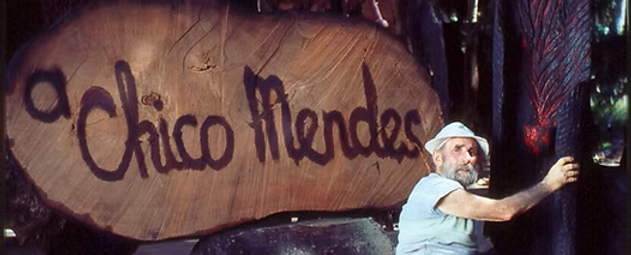
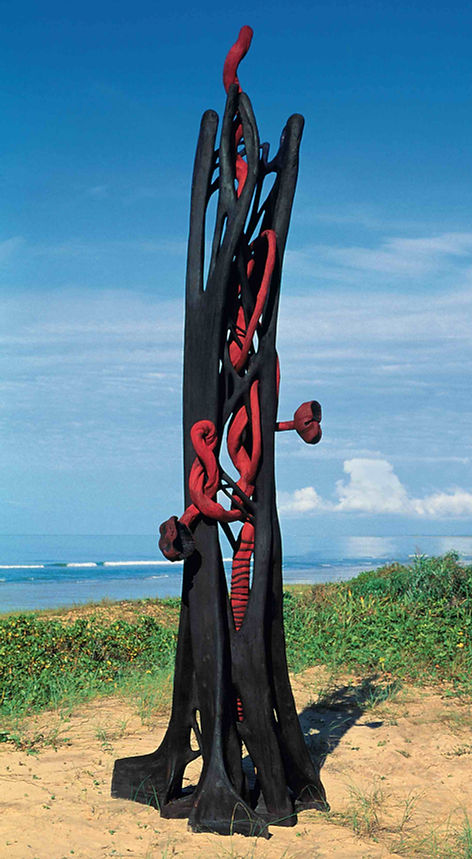
On December 22, 1988, Chico Mendes, the first to defend ecological awareness in Brazil and beyond, was assassinated. His efforts helped save nearly 1,200,000 hectares of forest. Frans Krajcberg paid tribute to him by sculpting a rubber tree wounded and incised with deep red lines evoking blood. A commemorative plaque in pyrographed wood bears the name of the martyred activist. In Rio Branco, in the state of Acre, Frans Krajcberg tirelessly photographed the devastated forest and collected scattered elements for his sculptures. He tried to convince farmers to stop cutting down trees, which earned him multiple death threats in return. He met Raoni, the Amerindian (indigenous) spiritual chief (Cacique), and committed himself to defending the cause of Amazonian indigenous peoples, maintaining both friendly and activist ties with them.
The 1990s brought him long-awaited recognition, definitively linking the artist with the activist.
In 1990, he was invited to Moscow for the International Ecology Congress. It was the first time he returned to Russia since his studies at the Leningrad Academy of Fine Arts.
In 1992, the World Environment Conference took place in Rio de Janeiro. The Modern Art Museums of Salvador and Rio honored Frans Krajcberg’s work. In Rio, his exhibition “Imagens do Fogo” attracted over 300,000 visitors around his images of forests devastated by fire, where trees seem to grow charred, where scents, sounds, and colors no longer correspond or blend. The forest, a metaphor for memory and the collective unconscious, once a terrestrial paradise, is now only a pile of wood carbonized by humans. The charred trunks, collected by Frans Krajcberg, stood upright and displayed majestically, carry a raw cry of suffering.
In Paris, the exhibition “Latin Americas” at the Centre Georges Pompidou showed several of his works. In 1996, he was at the heart of the “Villette-Amazone” exhibition at the Grande Halle de la Villette. Under the direction of Jacques Leenhardt and Bettina Laville, the exhibition placed the environment as a priority issue for the 21st century.
In 1998, he exhibited at the Fondation Cartier in the exhibition “Être Nature.”
In 2003, the exhibition “Art and Revolt,” organized at the new Montparnasse Museum, located in the alley where his studio is, paid homage to him.
Le « cri de Bagatelle »
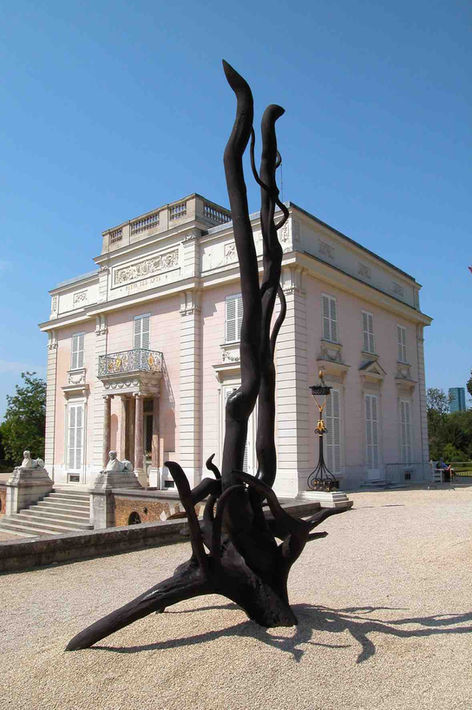
In 2005, it was Brazil’s year in France. For France, the General Commissioner was Jean Gautier, who had long been in contact with Brazilian circles and knew Frans Krajcberg. The Brazilian authorities wanted the event to be the occasion for a major retrospective in Paris. It would be of exceptional scale! The City of Paris made the Parc de Bagatelle available—a symbolic location since it was from the Longchamp plain that Alberto Santos Dumont made the first flight towards Brazil in 1906.
Sylvie Depondt took charge as General Commissioner and produced the catalogue. Claude Mollard and Pascale Lismonde published a detailed biography titled La Traversée du Feu (The Crossing of Fire). All teams involved, both Brazilian and those from the City of Paris’s Department of Green Spaces and Environment (DEVE), who coordinated the installation on site, invested themselves fully in this exceptional event.
But 2005 was also an opportunity to celebrate the centenary of the City of Paris’s acquisition of the Bagatelle estate and to recall that it was thanks to Jean Claude Nicolas Forestier that this was made possible. A visionary and conservator of the Bois de Boulogne, Forestier foresaw its dismantling if the site was acquired by developers.
Without hesitation, he risked his own fortune to launch an impressive press campaign, succeeding in his fight, and in 1905, the folly of the Comte d’Artois and his park became the property of the City of Paris. The theme of urban and peri-urban forests was therefore central—highly relevant in the context of today’s large metropolitan areas. It allowed reflection on the social and environmental role of these essential spaces for the balance of city dwellers. UNESCO became a partner, while Paris and the municipalities of Rio and São Paulo joined the debate. Frans Krajcberg saw this as a chance to launch his “Cry for the Planet,” which he wanted to resonate powerfully. The exhibition became Dialogues with Nature, a vibrant tribute to Frans Krajcberg and his work, as well as a meeting place and forum for discussion on the environment and the future of large cities. The exhibition opened on June 6 in the presence of many personalities, including Gilberto Gil, then Minister of Culture of Brazil, and Walter Salles, who dedicated one of his first films to Frans Krajcberg.
The exhibition remained open for several months and was actively supported daily by Frans Krajcberg himself, who did not hesitate to welcome visitors onsite. The Parisian public and passing tourists were charmed and fully embraced the message. Over 450,000 visitors came during the year! Schoolchildren and youth center groups who toured the exhibition throughout the summer had been prepared in advance by their teachers. They had already discovered Frans Krajcberg at the Montreuil Youth Press and Book Fair, where he was honored. The film by Éric Darmon and Maurice Dubroca, Portrait of a Revolt, helped them better understand this man whose vitality fascinated them. Some left the screening in tears and rushed to meet him. For Frans Krajcberg, it was a new experience—being recognized, listened to, and adored by such a young audience. He was present, ready to engage in dialogue, exchange, and even draw with them.
For Bertrand Delanoë, then Mayor of Paris, the elected officials of the municipality, and Brazilian representatives, this was an opportunity to affirm their commitment to the environmental debate. Frans Krajcberg established himself as a key player in the major discussion. The meetings brought together experts and officials who drafted a manifesto with concrete recommendations, officially signed in the fall. Its content was read in Curitiba during the international environmental meetings held at the end of the year. Frans Krajcberg’s long-awaited “Cry for the Planet” was launched for the first time.
The manifesto signed at Bagatelle in 2005 was presented in the environmental debates of Curitiba, Brazil’s “ecological capital,” which received a UN award for its exemplary urban development strategy. Frans Krajcberg was present and actively participated in the debates.
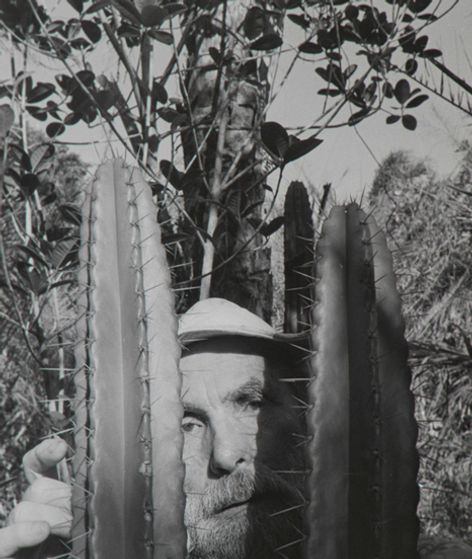
Frans Krajcberg donated around twenty emblematic works to the City of Paris to be installed in the Krajcberg Space—“his space”! From then on, he could permanently spread his message. For Frans Krajcberg, as he said, there would be “a Before and an After Bagatelle.”
© Luiz Garrana
The Cry for the Planet and COP21
In 2008, during the International Year of the Tree, Frans Krajcberg participated in the exhibition O Grito – Ano Mundial da Árvore at the Palacete das Artes Rodin in Bahia.
In 2012, his work was featured in João Pessoa in Natureza Extrema for the inauguration of the Estação Cabo Branco Museum. Ten years after the Bagatelle exhibition, his “Cry for the Planet” had firmly established itself in international environmental negotiations.
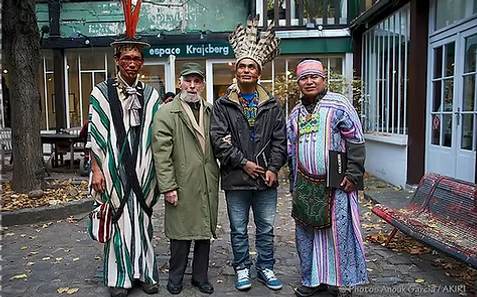
In 2015, Frans Krajcberg and the Frans Krajcberg Space played a major role at COP21 by hosting a delegation of Indigenous leaders, guardians of ecological, climatic, and cultural balance on a planetary scale. This initiative aimed to bring their voices—often absent—into the climate talks in Paris. For several months, the Frans Krajcberg Space became a laboratory for ideas and exchanges, an “Amazon antenna” in Paris.
2015, the Year of Climate, also saw O Grito para o Planeta resonate in Brazil at the Museum of the Environment (Museu do Meio Ambiente), located in the Botanical Garden of Rio de Janeiro. In Paris, the Krajcberg Space brought together representatives from France, Brazil, Peru, Indigenous peoples, and artists to advocate for the protection of the Amazon rainforest, essential to the planet’s ecological, climatic, and cultural balance.
Artists, activists, ecologists, political figures, and Indigenous representatives united to raise awareness of the urgent need to protect the world’s largest forest. Exhibitions, conferences, symposia, and screenings were organized to amplify the voices of the forest’s peoples.
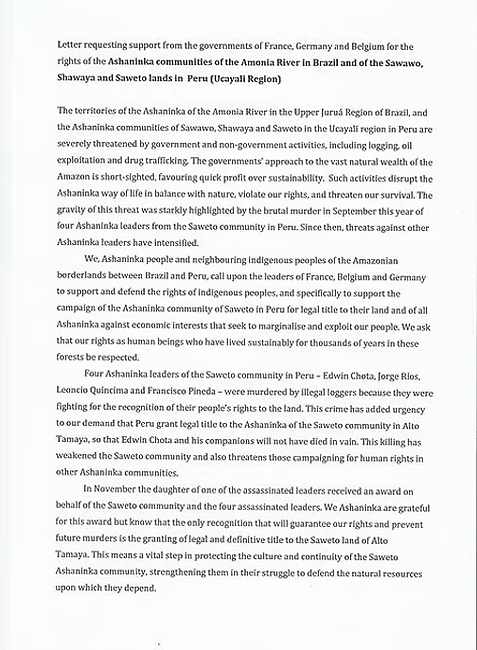
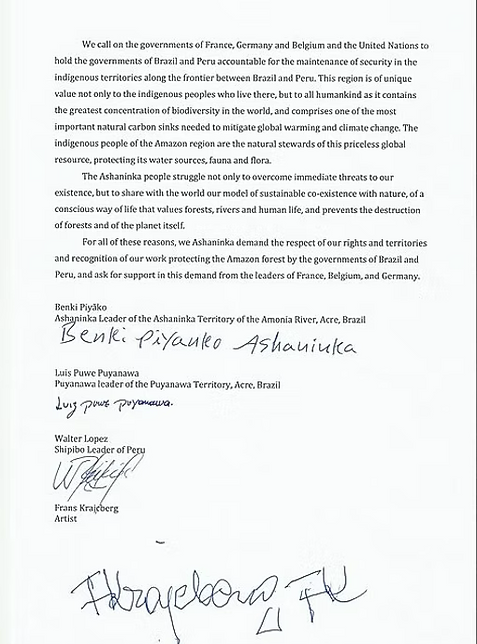
On November 24, the exhibition From the Rio Negro Manifesto to the Ashaninka Manifesto was inaugurated, while photographs of Frans Krajcberg’s works and portraits of Indigenous peoples by Anouk Garcia were installed on the esplanade of Gare Montparnasse.
From November 25 to 27, UNESCO and the Musée de l’Homme hosted a symposium titled “Indigenous Peoples Facing Climate Change,” with participation from Benki Piyãnko Ashaninka and Marishori Ashaninka, focusing on the Ashaninka’s fight for biodiversity protection in the Upper Juruá (Brazil) and Ucayali (Peru).
On November 28, a meeting with the Indigenous delegation took place at the Frans Krajcberg Space to discuss projects, issues, alerts, and demands in preparation for COP21.
From December 1 to 6, the Quai Branly Museum hosted a conference and film festival for the Videos Nas Aldeias (“Videos in the Villages”) project, with Vincent Carelli, showcasing 30 years of Indigenous cinema and highlighting the Ashaninka people’s struggles and initiatives (Brazil and Peru).
On December 7, at the Frans Krajcberg Space, the colloquium “Imaginary and Depiction of Indigenous Peoples” (fiction, essays, testimonies from the Amazon) was organized by the Sorbonne Nouvelle University Paris-3. Simultaneously, at Le Bourget, in the Indigenous Peoples Pavilion, another symposium addressed “The Peoples of the Amazon Borderlands Facing Climate Change,” with participation from Puwé Luiz Puyanawa, Yubé Huni Kuin, Moises Wewito, and Dora Jiribati. At the University of Toulouse Jean Jaurès, Department of Philosophy and Place du Capitole, public interventions, political, and artistic meetings were held with Benki Piyanko Ashaninka and Marishöri Najashi.
2025: Tribute and COP30 in Belém
On June 14, 2025, organized by the Friends of Frans Krajcberg, COAL, the Nuits des Forêts, and the Cité du Développement Durable, The Cry for the Planet – A Tribute to Frans Krajcberg and Sebastião Salgado was a commemorative event dedicated to two major figures committed to the defense of nature. Through this gathering in the Bois de Vincennes in Paris, artists, scientists, Indigenous activists, political leaders, and citizens were invited to make this “cry” resonate once again in response to the destruction of the Amazon rainforest and the ecological emergency. Inspired by Krajcberg’s lifelong commitment—he sought “forms for his cry” to denounce environmental devastation—and by the deeply humanistic work of Salgado, the event highlighted how two generations of artists shared a single voice in defense of the planet. At a time when the state of the environment calls for collective mobilization, the gathering aimed to awaken public awareness and carry this message forward to the COP30 in Belém, encouraging everyone to become an agent of change.
On November 14, 2025, on the occasion of COP30 in the Amazon, the Grito pelo Planeta launched by Frans Krajcberg resonated in Belém, extending the symbolic call that had been cried out a few months earlier in Paris. Ten years after the Paris Agreement, the Friends of Frans Krajcberg Association sought to bring this message to the Amazon in order to reaffirm the urgency of acting to preserve the living world. Gathered at the Museu das Amazônias, artists, scientists, activists, Indigenous representatives, and members of Brazilian and French civil society spoke out to express their own “cry” in the face of the ecological crisis and to propose concrete avenues for action. Through spiritual ceremonies, testimonies, filmed messages, and interdisciplinary exchanges, the event embodied a collective and international mobilization, paying tribute to the commitment of Frans Krajcberg and to the memory of Sebastião Salgado. In Belém, this cry became a symbol of hope and resistance, affirming the need for an alliance between cultures, knowledge systems, and generations to defend the planet.
