Rio Negro Manifesto
The Manifesto of Integral Naturalism
Pierre Restany, 1978
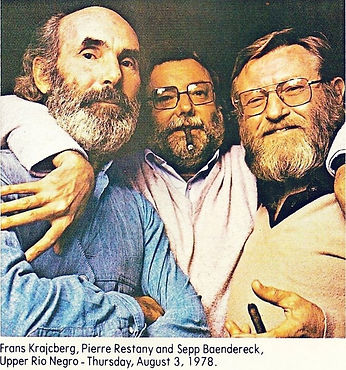
In 1978, Pierre Restany joined Sepp Baendereck and Frans Krajcberg on an expedition to the Amazon. While traveling up the Rio Negro, Pierre Restany wrote the Manifesto of Integral Naturalism, also known as the Rio Negro Manifesto. In it, he explores his own vision of Art confronted with Frans Krajcberg’s “alternative” aesthetics, based as much on reflection as on instinct. The launch conferences in Rio, São Paulo, and Brasilia sparked controversy.
“The Amazonian nature challenges my sensitivity as a modern man. It also calls into question the scale of traditionally recognized aesthetic values. The current artistic chaos is the result of urban evolution. Here, we are faced with a world of forms and vibrations, the mystery of continuous change. We must learn to take advantage of it. Integral nature can give a new meaning to individual values of sensitivity and creativity.
We launched the Rio Negro Manifesto on the day Brazil opened up to democracy: the military had just granted amnesty to opponents. It was the first debate after the dictatorship; we had never talked about the destruction of forests. The attacks were fierce. Some could not accept that three ‘gringos’ were talking about Brazil. The manifesto was presented in Curitiba, New York, Paris, Rome, and Milan.”
— Frans Krajcberg
Pierre Restany - Upper Rio Negro - Thursday, August 3, 1978
In the presence of Sepp Baendereck and Frans Krajcberg
“The Amazon today constitutes the ultimate refuge reservoir of integral nature on our planet.
What kind of art, what system of language can evoke such an atmosphere—exceptional in every way, extraordinary compared to common sense?
An essentialist and fundamental type of naturalism, which opposes realism and the continuity of the realistic tradition, the realistic spirit beyond the succession of its styles and forms.
The spirit of realism throughout the history of art is not the spirit of pure observation, nor the testimony of affective availability. The spirit of realism is metaphor; realism is the metaphor of power: religious power, monetary power in the Renaissance era, political power thereafter, bourgeois realism, socialist realism, and the power of consumer society through pop art.”
Naturalism is not metaphorical. It does not reflect a will to power but rather another state of sensitivity, a major opening of consciousness. The tendency toward objectivity in observation reflects a discipline of perception, a full availability to the direct and spontaneous message of immediate data in consciousness. A kind of journalism, but transferred to the realm of pure sensitivity: the sensitive information about nature.
To practice this availability in relation to the natural given is to accept the modesty of human perception and its limits in the face of a totality that is an end in itself. This discipline, the awareness of one’s own limits, is the primary quality of a good reporter: it is how one can transmit what one sees with as little distortion of the facts as possible. Naturalism, as conceived here, implies not only the greatest discipline in perception but also the greatest openness of the human being. Ultimately, nature simply is, and it exceeds us in the perception of its duration. But in the space-time of a human life, nature is the measure of one’s consciousness and sensitivity.
Integral naturalism is allergic to any form of power or metaphor for power. The only power it recognizes is not the abusive one of society, but the purifying and cathartic power of imagination in the service of sensitivity.
This naturalism is individual in nature: the naturalist option, as opposed to the realist option, is the result of a choice that engages the totality of individual consciousness. This option is not merely critical; it is not limited to expressing man’s fear in the face of the danger industrial and urban civilization poses to nature. It represents the emergence of a global stage of perception, the personal transition to planetary consciousness.
We are living in a time of double reckoning. The end of the century coincides with the end of the millennium, with all the transfers of taboos and collective paranoia that such temporal recurrences imply—starting with the transfer of the fear of the year 1000 to that of the year 2000, with the atom replacing the plague.
Thus, we are living in a time of reckoning—a reckoning of our past that opens onto our future. Our First Millennium must herald the Second. Our Judeo-Christian civilization must prepare its Second Renaissance. The return to idealism in the heart of a super-materialistic 20th century, the renewed interest in the history of religions and occult traditions, the increasingly urgent search for new symbolist iconographies—all these symptoms reflect a process of the dematerialization of the object initiated in 1966, a major phenomenon in the history of contemporary Western art.
After centuries of tyranny of the object—culminating in its apotheosis as the synthetic language of consumer society—art now doubts its material justification. It dematerializes, it becomes conceptual. The conceptual approaches in contemporary art only make sense when examined through this self-critical lens. Art has placed itself in a critical position. It questions its immanence, its necessity, its function.
Integral naturalism is one answer. Precisely through its integrist nature—meaning its generalization and radicalization of the perceptive structure, its planetary reach of consciousness—it presents itself today as an open option, a guiding thread amid the chaos of contemporary art. Self-criticism, dematerialization, idealist temptation, underground symbolist and occultist paths—this apparent confusion may one day be reorganized through the notion of naturalism as an expression of planetary consciousness.
This perceptual restructuring represents a true mutation, and the dematerialization of the art object, its idealist interpretation, the return to the hidden meaning of things and their symbolism—all these form a set of phenomena that operate as a preliminary step to our Second Renaissance, a necessary stage in the final anthropological transformation.
Today, we live with two senses of nature. The ancestral one: nature as planetary given. The modern one: nature as industrial and urban acquisition. One can choose one or the other, deny one in favor of the other—what matters is that these two meanings of nature be lived and embraced in the integrity of their ontological structure, in the perspective of a universalization of perceptual consciousness. The self embracing the world and becoming one with it, in harmony and agreement, with emotion accepted as the ultimate reality of human language.
Naturalism, as a discipline of thought and perceptual consciousness, is an ambitious and demanding program—one that far exceeds the currently hesitant perspectives of ecological thinking. It is a matter of fighting not only objective pollution, but above all subjective pollution—the pollution of the senses and the brain, more than that of the air or the water.
Such an exceptional context as the Amazon gives rise to the idea of a return to original nature. Original nature must be exalted as a hygiene of perception and a mental oxygen: an integral naturalism, a gigantic catalyst and accelerator of our faculties to feel, to think, and to act.”