
.jpg)
Revolts
“Fire is death, the abyss. Fire has always been with me. My message is tragic. I show the crime. I gather the evidence, bring it together, and add more—I want to give my revolt the most dramatic and violent face. I want my works to be a reflex of burns.”
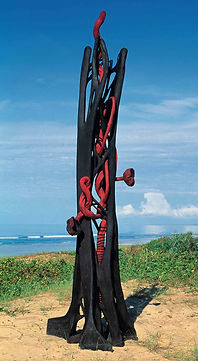
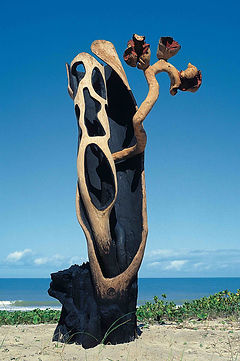
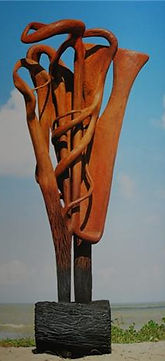
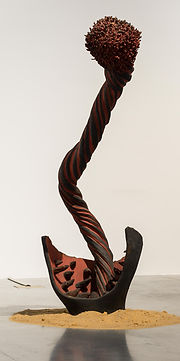
At the end of the 1980s, after his travels in Mato Grosso and the Amazon, Frans Krajcberg began working with “burned woods”, collected from sites of deforestation. His “Revolts” are assemblages made from natural elements—trunks, vines, roots—gathered from forests devastated by fires, then transformed with a blowtorch. Fire hardens the wood, giving it a certain resistance. The work is then enhanced with black or red—colors derived from vegetal charcoal, stones, or natural pigments—that protect, heal, and camouflage like war paint, but also like ritual protective poultices.
Set on natural bases, pierced by light, his “burned woods”, steles or totems, sound like tragic alarm sirens. With them, Frans Krajcberg asserts that death is not an end. He challenges it through his sculptures. The purified, transformed, and magnified elements are reborn.
His “burned barks” echo his burned woods. Between painting and epidermal fragments, their tragic economy contrasts with the theatricality of his “conjuntos.”
Frans Krajcberg installed in front of his own house a monumental sculpture eleven meters high, named “Memory of Destruction.” Emptied of their substance, two dead tree trunks—dried out and burned—are interlocked and raised toward the sky. Their dramatic silhouette speaks of mourning the vegetal, but also the human body, a remembrance and refusal to forget the past. Like African ancestors buried within homes to protect their living tribe, this sculpture serves as a spiritual guardian of the artist’s private space.
"I am a man, marked by the fire"
.jpg)